
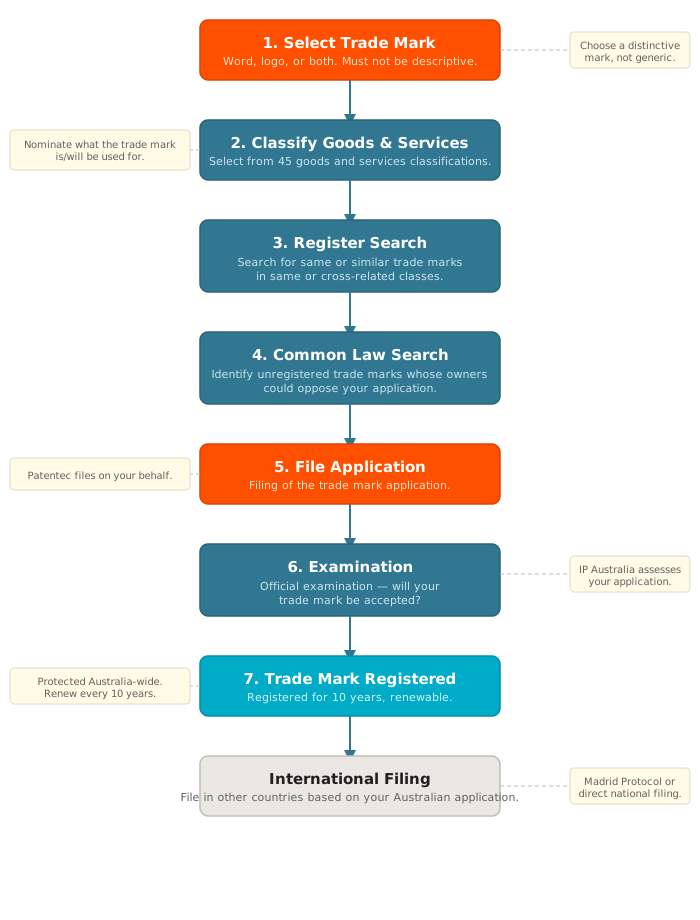
Step 1: Selecting the trade mark
The process begins with choosing an appropriate trade mark — the sign that will distinguish your goods and services from those of other traders. In most cases, this is a business name, a product brand, or a specific tagline. If you also use a logo, this should be filed as a separate trade mark application.
Distinctiveness is the key criterion. A trade mark that merely describes the goods or services it covers will likely be refused during examination, because other traders have a legitimate need to use those descriptive words. The strongest trade marks are inherently distinctive — they suggest the nature of the goods or services without directly describing them.
The strongest trade marks are distinctive, not descriptive. Choose a mark that suggests rather than describes.
Step 2: Classifying goods and services
Trade marks are registered in respect of specified goods and services, classified under the internationally recognised Nice Classification system across 45 classes. This means identical trade marks can coexist on the register for unrelated goods — for example, the same word mark could be registered by one party for beer and by another for footwear.
Selecting the right goods and services is critical because once an application is filed, the scope cannot be broadened — only narrowed. While subsequent applications can be filed for additional goods and services, this results in a later priority date for those additional specifications.
Once your trade mark application has been filed, the scope of goods and services cannot be broadened.
Patentec will help you select specifications that are broad enough to provide meaningful protection, while remaining commercially justified and defensible against non-use challenges.
Step 3: Register search
Before filing, the trade mark register must be searched to identify any earlier filed marks that could block your application. This is a step where thoroughness matters — a proper search goes well beyond a simple keyword match.
An effective search must identify not only identical marks, but also phonetically similar marks, visually similar marks, and marks with similar meanings. The search must also extend beyond the exact classes of the nominated goods and services to include associated classes identified by the cross-class search list.
This register search mirrors what the government trade mark examiner will conduct during official examination. Identifying potential conflicts before filing allows you to make informed decisions about how to proceed.
A proper trade mark search must go beyond exact keyword matching to identify phonetically, visually, and conceptually similar marks.
Step 4: Common law search
Many applicants gain confidence from a clear register search and proceed directly to filing. This can be a costly mistake.
In the marketplace, there may be traders who have established rights in a trade mark through use, even though they have never registered it. These are known as common law or unregistered trade marks, and they carry real legal weight.
A common law trade mark owner can oppose your application during the two-month opposition window after acceptance, arguing that they were using the mark first. Even if they miss the opposition window, they may subsequently register their own mark based on prior use — leaving both parties with registered rights to the same or similar mark, which creates significant commercial uncertainty.
Common law trade mark owners can oppose your registration or establish their own rights based on prior use in the marketplace.
To reduce this risk, we recommend a common law search — a survey of the marketplace to identify potentially conflicting unregistered trade marks — before committing to the filing of your application.
Step 5: Filing the application
Assuming the register and common law searches do not reveal any potential conflicts, the next step is to file the trade mark application with IP Australia. Once filed, the application enters the queue for official examination, which is typically conducted by a government trade mark examiner in Canberra.
Filing establishes your priority date — the date from which your rights are measured against later applicants. It also starts the clock for international trade mark filings, which should ideally be lodged within six months to claim the benefit of the Australian priority date.
Step 6: Examination
During examination, the government examiner assesses two primary issues: whether the trade mark conflicts with any earlier filed marks, and whether the mark is too descriptive of the nominated goods and services.
Conflict with earlier marks. If the examiner identifies a potentially conflicting mark, it may not be fatal. Patentec can explore several strategies, including demonstrating your prior use in the marketplace, seeking removal of the conflicting mark for non-use, or obtaining a letter of consent from the earlier trade mark owner.
Descriptiveness objections. If the examiner considers the mark too descriptive, it may be possible to overcome the objection by adducing evidence of acquired distinctiveness — demonstrating that through extensive use, the public has come to associate the mark with your goods and services. Generally, at least three years of prior use is needed to build a persuasive case.
Examination typically takes six to eleven weeks from filing, although expedited examination can be requested and completed within five working days.
Step 7: Registration
Once the application passes examination, the trade mark is accepted and advertised in the Australian Official Journal of Trade Marks for a two-month opposition period. If no opposition is filed, or any opposition is resolved in your favour, the trade mark proceeds to registration.
A registered trade mark provides protection for an initial period of 10 years from the filing date, and can be renewed indefinitely in 10-year increments by paying the government renewal fee.
International protection
Trade mark rights are territorial, and an Australian registration protects your brand in Australia only. If you trade internationally, foreign trade mark applications should be filed within six months of the Australian filing date to claim the benefit of the original priority date under the Paris Convention.
For businesses seeking protection in more than four countries, the Madrid System provides a cost-effective mechanism for filing a centrally administered bundle of international applications. For a detailed overview, see our guide to international trade marks.
File your international trade mark applications within six months of the Australian filing to preserve your priority date.
If you are ready to begin the trade mark registration process, contact Patentec for a complimentary consultation. We will guide you through every stage — from initial searching through to registration and beyond.