
What is the PCT patent application?
The Patent Cooperation Treaty is an international treaty administered by WIPO (the World Intellectual Property Organization) with 158 contracting states. It provides a unified mechanism for seeking patent protection across multiple countries through a single international filing, rather than requiring separate applications in each jurisdiction from the outset.
The PCT application is typically filed after a provisional patent application and before entering the national phase in individual countries. By combining the 12-month provisional period with the PCT, you can have up to 30 months from your initial priority date before selecting your countries of interest — a substantial window for commercial development, fundraising, and strategic planning.
The PCT system gives you up to 30 months from your priority date to decide which countries to enter — without losing any rights.
The PCT application process
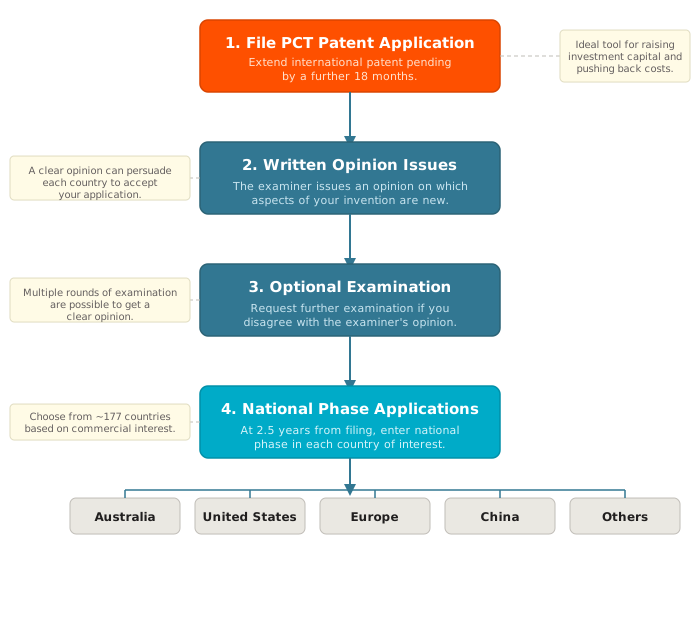
The PCT Patent Application process
A PCT application filed at the end of the provisional period extends the international patent pending period by a further 18 months. During this time, the PCT system conducts an international search, issues a written opinion on patentability, and provides an optional examination process — all before you commit to the cost of filing in individual countries.
Deferring national phase costs
National phase entry — where patent applications are filed in each country of interest — is typically the most expensive stage of the patent process. It involves filing fees, translation costs, and local attorney fees in every jurisdiction you select.
The PCT application defers these costs by 18 months beyond the provisional period. This additional time is commercially valuable: it allows you to build further revenue, secure investment, refine your product, and develop a clearer picture of which markets justify the expenditure of national filing. For start-ups and early-stage businesses, this deferral can be the difference between a sustainable patent strategy and an unsustainable one.
Where more than two or three countries are being considered for patent protection, the PCT route is almost always more cost-effective than filing directly in each country at the end of the provisional period.
Centralised search and written opinion
One of the most significant advantages of the PCT system is the centralised international search and written opinion. The PCT examiner conducts a thorough search of prior art and issues a written opinion on the novelty, inventive step, and industrial applicability of each claim in the application.
This written opinion provides an authoritative, early indication of how the invention is likely to fare during examination in individual countries. While it is technically an opinion rather than a binding decision, it carries substantial weight with national examiners. A favourable PCT opinion is persuasive on examiners in Australia, the United States, Europe, and other major jurisdictions — often resulting in smoother prosecution and reduced costs at the national phase.
If an international-type search was conducted during the provisional stage, the PCT written opinion will typically build on that earlier assessment. This means you enter the PCT stage with a strong indication of how the examiner will assess your claims, and can refine the specification accordingly before the opinion is issued.
Optional international preliminary examination
If the PCT written opinion raises objections, you have the option of requesting an international preliminary examination. This provides a formal opportunity to amend the claims, submit arguments, and engage directly with the examiner before entering the national phase.
The goal is to secure a favourable international preliminary report on patentability (IPRP), which can then be relied upon during national prosecution. Addressing objections centrally through the PCT — rather than country by country — can deliver significant cost savings, particularly when entering a large number of jurisdictions.
Strengthening your investment position
The PCT written opinion is also a powerful tool for attracting investment. Early in the patent process, there is inherent uncertainty about whether a patent will ultimately be granted. Investors are naturally cautious about backing an invention whose patent prospects are unclear.
A clear, favourable PCT written opinion provides objective, examiner-level evidence that the invention is likely to be patentable. This reduces investment risk and can be decisive in securing funding. It demonstrates that the intellectual property has been independently assessed and that there is a defensible barrier to entry for competitors.
A favourable PCT written opinion gives investors confidence that your patent protection is on solid ground — often the deciding factor in securing funding.
Entering the national phase
At the conclusion of the PCT period, you select the countries where enforceable patent protection is required. National phase entry typically occurs at 30 or 31 months from the original priority date, depending on the jurisdiction.
Most commercially significant countries — including Australia, the United States, Europe, China, Japan, South Korea, and India — are accessible through the PCT route. A small number of jurisdictions, such as Argentina and Taiwan, require direct filings outside the PCT system.
For a detailed discussion of country selection strategies and what happens after national phase entry, see our guides on international patents and how long it takes to get a patent.
Is the PCT right for your invention?
The PCT application is the recommended route for any inventor or business that is considering patent protection in more than one country. It provides additional time, centralised examination, and cost deferral — all of which support better-informed commercial decisions.
If you have an invention with international commercial potential, contact Patentec for a complimentary consultation. We will assess your situation and recommend a PCT strategy aligned with your commercial goals and budget.